
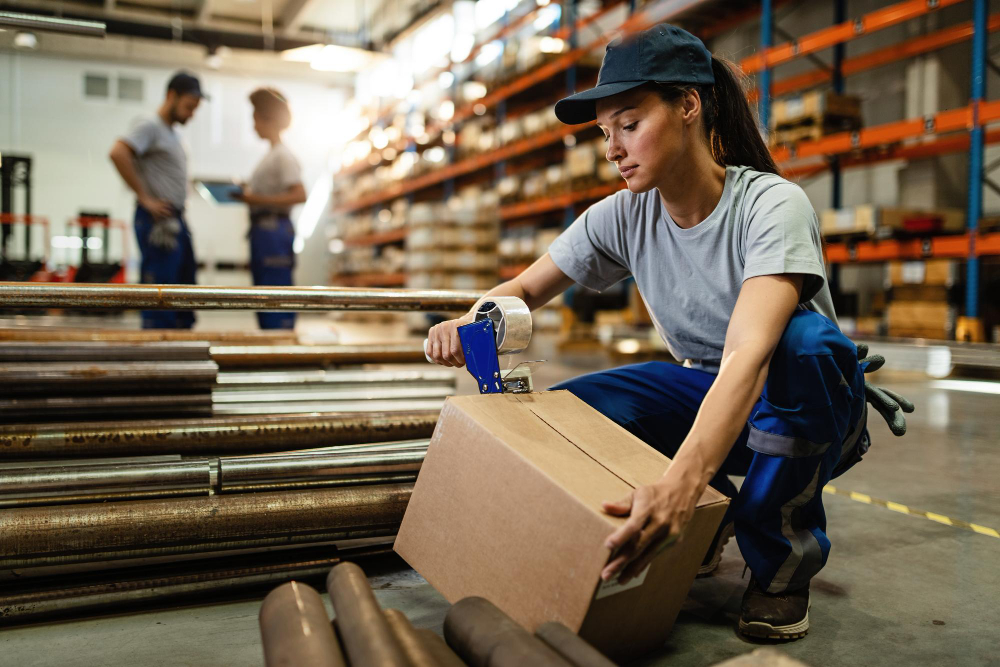
Outsourcing fulfillment: what you gain and what you lose in the day-to-day warehouse operation.
Table of contents
The decision to outsource fulfillment is often presented as a strategic move: less internal management, more focus on sales, less operational friction. On paper, it all makes sense. However, there is one place where that decision becomes tangible very quickly: the day-to-day reality of the warehouse.
Because outsourcing does not eliminate picking. It moves it out of your space. And that changes many things that are not always considered when the decision is made.
When fulfillment is outsourced, the warehouse stops being the protagonist
One of the first effects of outsourcing is a sense of relief. Orders go out, deadlines are met, and operational pressure drops. Picking is no longer at the center of daily conversations.
That initial stability is real and, in many cases, necessary in early stages or when growth has exceeded internal capacity. The provider brings structure, method, and an operation that works from day one.
The problem is that this same structure is designed for many clients at once. Picking stops adapting to the nuances of each business and starts operating within a shared framework. As long as everything fits, it goes unnoticed. When it no longer fits, it becomes very noticeable.
What you gain: less visible friction and more short-term predictability
Outsourcing fulfillment reduces internal decision-making. There is no need to reorganize routes, rethink picking methods, or constantly adjust the layout. The external warehouse absorbs the work and turns picking into a service.
This translates into fewer daily urgencies, less dependence on specific individuals, and a more stable sense of control, at least in the short term. For many operations, this balance is exactly what they need at a given stage.
From the outside, everything looks simpler. And in a way, it is.
What you lose: fine-grained control over order preparation
The other side appears when you look at the details. Outsourced picking is not designed for a single catalog, a single order type, or a single seasonality. It is optimized for an average.
When the business begins to develop specific needs — special orders, frequent SKU changes, irregular peaks — the system does not truly adjust. It adapts as far as it can.
The result is usually not a major failure, but a buildup of small frictions: more incidents, less ability to react, greater dependence on processes that are not directly controlled. Picking works, but it stops being a lever for improvement.
Keeping picking in-house is not easier, but it is more adaptable
When fulfillment is managed internally, picking returns to the center. Problems become visible sooner, but they can also be worked on.
The routes are obvious. You can see where time is lost, where errors repeat, where the system forces improvisation. The picking cart, the way orders are grouped, or the organization of zones stop being minor details and become decisions with real impact.
It is not a more comfortable path, but it is more flexible. In-house picking allows the operation to be adjusted gradually, as long as it is designed with criteria and not allowed to grow in an improvised way.
Outsourcing does not eliminate complexity, it shifts it
A common mistake is to think that outsourcing fulfillment simplifies logistics. In reality, the complexity remains; it just happens elsewhere.
Issues do not disappear, they are managed remotely. Decisions are made with less context. The ability to test quick changes is reduced.
In a well-organized in-house picking operation, complexity is visible and therefore workable. Multi-order carts can be introduced, routes reorganized, or flows adjusted to better absorb volume without adding unnecessary pressure.
A decision that usually responds to a stage, not an absolute truth
Many operations outsource at one stage and bring fulfillment back in-house later. Or the other way around. The problem is not the change, but failing to understand how it affects the day-to-day warehouse reality.
Fulfillment is not just where orders are prepared. It is how they are prepared and how that preparation is experienced every day. That difference ends up influencing stability, service quality, and the ability to grow without breaking the operation.
Deciding by looking at warehouse reality
Outsourcing fulfillment or keeping it in-house is not decided by numbers alone. It is decided by observing how work is done, where control is lost, and what kind of problems you want to deal with.
Because there will be problems in both models. The difference lies in whether you prefer visible, adjustable problems or encapsulated problems that are harder to influence.
On this blog, we continue analyzing how seemingly small decisions in picking — methods, routes, carts — end up making the difference in the day-to-day warehouse operation, even when fulfillment is not managed internally.